

In fields such as particle size analysis, precision instrument calibration, advanced materials R&D, and semiconductor manufacturing, size standard microspheres serve as essential “reference rulers.” The accuracy and stability of these rulers are critical for obtaining precise data and reproducible experimental results. Today, we will explore the applications of silica standard microspheres, share practical tips, and explain how to select the right size standard silica microspheres.
1. What are Size Standard Silica Microspheres?
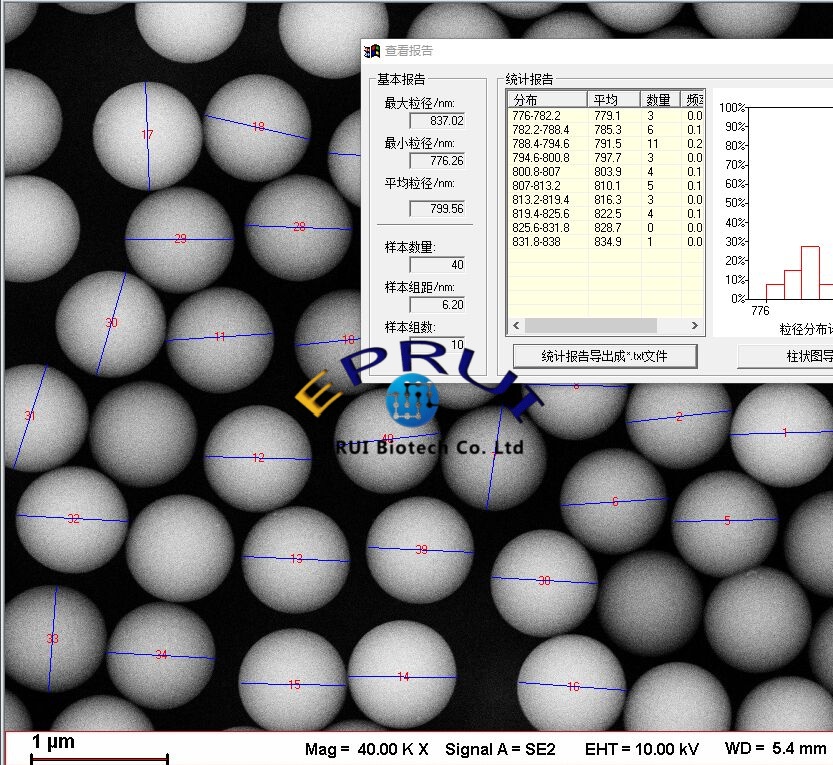
Silica size standard microspheres are spherical particles made from high-purity amorphous silica and are widely recognized as a primary reference material for particle size analysis. Compared to size standard polystyrene (PS) microspheres, although both can be used for instrument calibration, their material properties differ significantly. Polystyrene microspheres are relatively soft, susceptible to organic solvents and intense light, and cannot withstand high temperatures while silica microspheres show excellent chemical stability, a broad temperature tolerance, and high mechanical strength. These properties make them better suited for harsh industrial environments and long-term precision measurements, making silica microspheres the preferred reference particles in high-end laboratories, semiconductors, and materials science.
The quality of size standard microspheres is judged by three core parameters: particle size uniformity, sphericity, and dispersibility. These are the prerequisites for any successful calibration or experimental work.

2. Practical Applications & Best Practices
🔬 Precision Instrument Calibration (Laser particle size analyzers, electron microscopes, flow cytometers, etc.)
This is the most important application. Measuring Instrument used for a long term can cause drift in optics, fluidics, or detection parameters, requiring regular calibration with standard particles.
✅ Best Practices:
- Choose the right particle size based on the instrument’s measurement range. For nanoscale instruments, use 20 nm-1um; for micron-level detection, prefer 1–50 μm.
- Shake thesuspended microspheres thoroughly before use. If slight aggregation occurs, use low-temperature, short-duration ultrasonication. Avoid prolonged high-power sonication to prevent particle damage.
- Perform calibration in a room-temperature, light-protected environment. Avoid high temperatures and intense light exposure.
- Keep calibration data and reports. Establish an instrument quality control log; regular calibration once a week is recommended.
🧪 Scientific Research Experiments (Photonic crystals, nanomaterials, biomedical research)
Due to their uniform spherical shape and stable properties, silica microspheres are often used as building blocks, synthetic templates, or biological carriers.
✅ Best Practices:
- For aqueous systems, use the silica watersolution directly. For ethanol or organic phases, first confirm dispersion compatibility.
- For biological experiments, prioritize products with low non-specific adsorption and no fluorescence interference to avoid affecting immunoassays or nucleic acid isolation.
- If antibody or active molecule conjugation is required, pre-select amino- or carboxyl-functionalized microspheres to avoid secondary modification steps.
🏭 Industrial Quality Control (Semiconductor CMP, displays, photovoltaics, ceramics)
Industrial production lines demand extremely high particle stability and weather resistance – an area where silica microspheres outperform traditional polymer microspheres.
✅ Best Practices:
- Under high-temperature, strong acid, or strong alkali conditions, never use polystyrene microspheres; always choose silica.
- For powder microspheres, prepare dispersion solutions as needed and use immediately. For long-term storage, keep sealed and moisture-proof.
- For batch production quality control, choose products with strong batch-to-batch consistency and complete inspection reports to enable traceability.
3、EPRUI’s Product Advantages
Based on the above application requirements,EPRUI Biotech Co. Ltd. has developed a full series of silica standard microspheres which satisfy the needs covering all industries.
- Extreme Particle Size Accuracy, Zero Data Deviation
Size range: 20 nm-50um, extremely narrow size distribution, excellent sphericity. Strict process control ensures batch-to-batch consistency, eliminating calibration failures and experimental data fluctuations caused by non-uniform particle sizes. Fully meets metrology-grade reference material requirements.
- Superior Physicochemical Properties for Harsh Conditions
High-purity silica substrate, chemically inert, resistant to acids, alkalis, and organic solvents. UV-resistant. No deformation, volatilization, or degradation under high temperature or light exposure. Significantly more durable than PS microspheres, suitable for complex experiments and industrial environments.
- Excellent Dispersibility for Easier Operation
Smooth, clean particle surface, minimal primary particle agglomeration. Even if slight aggregation occurs, short ultrasonication can quickly redisperses them. Our silica microspheres can be uniformly dispersed in water, ethanol, and other common solvents. Simple sample preparation and instrument operation, improving experimental efficiency.
- Compliant and Traceable, Safety Guaranteed
Each batch comes with a complete COA (Certificate of Analysis), including particle size, sphericity, purity, and other traceable parameters. Non-toxic, environmentally friendly, no fluorescence interference, low non-specific adsorption. Perfect for biomedical, food testing, and other high-safety applications.
- Customization Available
In addition to standard specifications, custom particle sizes and surface functional groups (e.g., amino, carboxyl) are available, providing a one-stop solution for customized experimental and production needs.
4. Summary
EPRUI Biotech Co. Ltd. specializes in providing various monodisperse microspheres products. In addition to size standard microspheres, EPRUI also provides flow cytometry fluorescent microspheres, polystyrene microspheres, PMMA microspheres, PLLA microspheres,wafer calibration standards, and a full range of products covering biological research, in vitro diagnostics, semiconductor manufacturing, materials R&D, and more providing one-stop microsphere solutions.